Know what you're buying before you hand over the money
We meet you at the seller's driveway or the dealer's lot, inspect the car top to bottom, drive it, scan every computer module and tell you what we found, including whether it's likely to pass your state inspection. Repair estimates are available if you want them. Can't get there yourself? We'll inspect it without you and tell you whether to buy it.
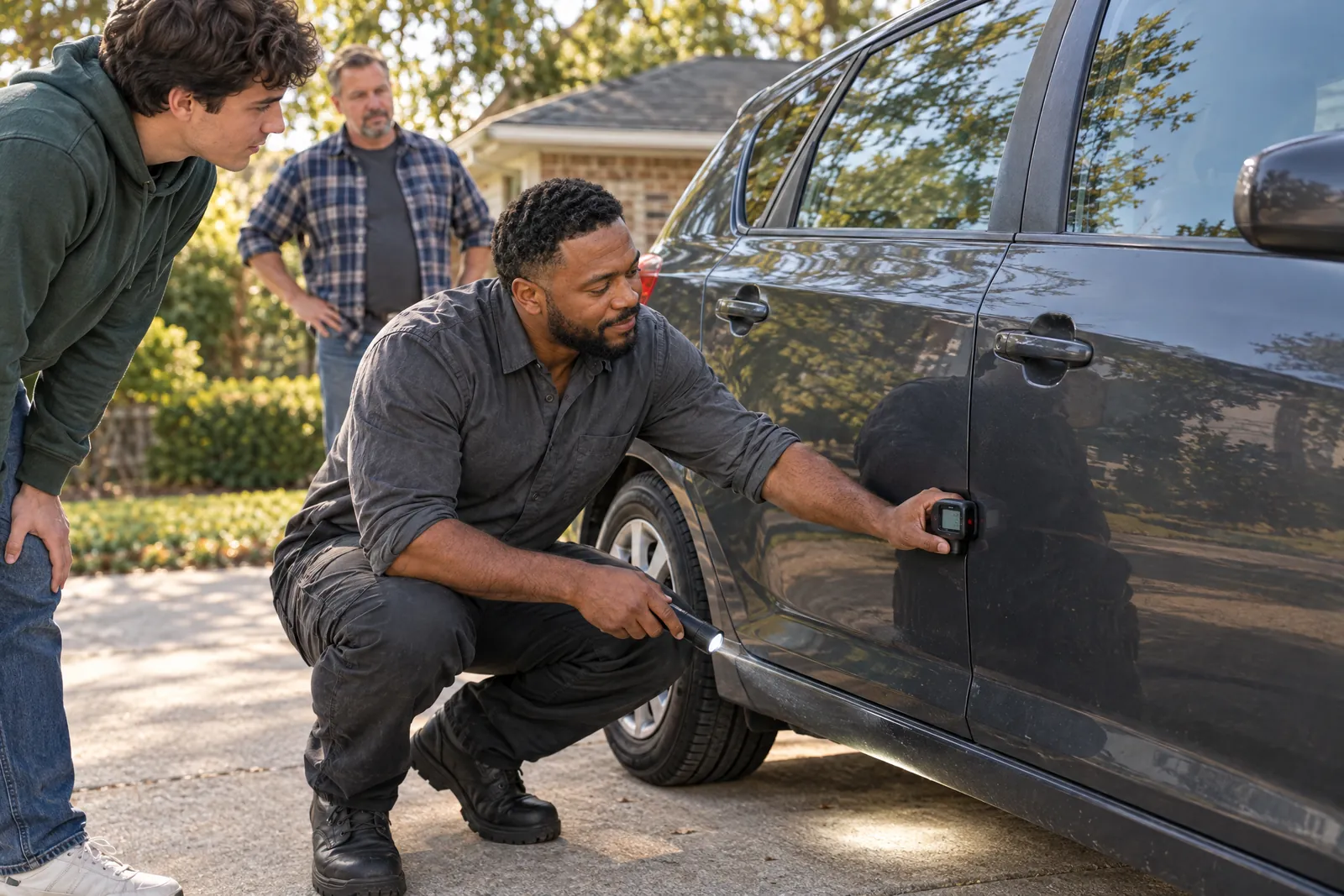
We inspect it in your absence and give you a straight answer
The car is across town, the seller can only do Tuesday at 10, or you're buying from out of state. Send us the listing and the seller's contact details. We set the time with the seller, meet them at the car, inspect it and road-test it while you're at work.
- We arrange it with the seller. You share the seller's name and number; we confirm the time and location and let you know when we're on site.
- We inspect and drive the car. The same full inspection, computer scan and road test you'd get if you were standing next to us.
- We call or text you from the car. A short summary of what we found while the seller is still there, so you can ask questions or make an offer on the spot.
- You get our recommendation in writing. Buy it, negotiate the price down (with optional repair estimates to back you up), or walk away, plus our state-inspection outlook.
The best time to buy a used car is winter
Used-car prices follow the thermometer. They fall from November to March and bottom out between New Year's Eve and the end of February, then climb in spring when tax refunds bring buyers back to the lots.
- +55.6%more good deals than average in January, the best month of the year to buy usediSeeCars, 40M+ used-car sales, 2024–Oct 2025
- +65.5%more deals on Martin Luther King Jr. Day, the single best day. New Year's Eve and Day follow at +58.6%iSeeCars, 2025
- +36.2%more deals in February. June is the worst month, with 22.8% fewer deals than averageiSeeCars, 2025
- +2.3%rise in wholesale used-car values from January to March 2026, as dealers stocked up for tax-refund shoppersCox Automotive, Manheim Used Vehicle Value Index, Q1 2026
- More deals than average
- Fewer deals than average
Show the numbers
| Versus average | |
|---|---|
| January | +55.6% |
| February | +36.2% |
| May | -22.2% |
| June | -22.8% |
| July | -22.1% |
| December | +15.2% |
iSeeCars analysis of 40M+ used-car sales, 2024–Oct 2025. A deal is a car priced at least 10% below market value.
“In general, used car prices follow the average temperature, with both falling between November and March and bottoming out between December 31 and February 28.”Karl Brauer, executive analyst, iSeeCars
iSeeCars counts a “deal” as a car priced at least 10% ($2,689) below market value. Cold weather also helps the inspection: a cold start exposes weak batteries, slow cranking and noisy lifters that a warm engine can hide.
A dark check-engine light doesn't mean nothing's wrong
Every car built since 1996 has a computer that watches the engine, transmission and emissions systems. When a sensor reads out of range, the computer stores a fault code, also called a diagnostic trouble code: a short letter-and-number label for what it saw. P0300 means the engine is misfiring. P0420 means the catalytic converter isn't cleaning the exhaust the way it should. The code turns on the check-engine light.
An unscrupulous seller can erase those codes with a $20 scan tool, or by disconnecting the battery, the day before you look at the car. The light goes dark and stays dark until the computer catches the fault again, which can take days or hundreds of miles.
How your mechanic catches it
- Readiness monitors. Clearing codes or disconnecting the battery resets the car's self-tests to “not ready”. A row of incomplete monitors on a car that's supposedly been driven daily is a warning sign.
- Distance and time since codes were cleared. The computer records how many miles have been driven, and how many engine warm-ups have happened, since the last reset. “Cleared 12 miles ago” tells you a lot.
- Permanent codes. Many newer cars keep a permanent copy of a serious fault that a scan tool or dead battery can't erase. It only clears once the problem is fixed and the car re-tests itself.
- Pending codes and every module. We read faults the computer has seen once but not yet confirmed, plus the transmission, ABS, airbag and body modules that a basic code reader never touches.
Deceptive sellers are much easier to spot with the right tools. If the codes were cleared recently, we tell you, and we tell you what to ask the seller.
Ten checks, top to bottom
Engine and under the hood
Oil, coolant and brake fluid condition, belts, hoses and a battery load test. We look for active leaks and the signs of a failing head gasket: milky oil, coolant loss, white exhaust smoke.
Undercarriage and frame
Structural rust, subframe damage, previous accident repairs, and the silt lines, corrosion and fire damage that history reports miss.
Suspension and steering
Shocks, struts, control arms, ball joints, tie rods and wheel bearings, checked for play and leaks.
Brakes and tires
Pad thickness, rotor condition, brake fluid moisture, tread depth on every tire and wear patterns that point to alignment or suspension problems. We also read the tire date codes.
Electrical and electronics
Dashboard warning lights, a full computer scan of every module, readiness monitors, power accessories, lights, infotainment, backup camera and climate control.
Transmission and drivetrain
Fluid color and smell where it can be checked, shift quality, engagement delay, CV boots, axles and differential leaks. On 4WD and AWD vehicles we engage the transfer case.
Body, paint and glass
A paint-depth gauge to find repainted panels, panel gaps that don't match, overspray on trim and rubber seals, and chips or cracks in the windshield.
Interior and safety systems
Seatbelts, airbag warning light, seats, locks and windows. We check for damp carpet, a musty smell or rust on seat rails, which are signs of flood damage.
Will it pass state inspection?
We check what state safety and emissions inspections look at: lights, brakes, tires, glass, wipers, horn, exhaust leaks, the check-engine light and the readiness monitors. Cars with recently cleared codes often get turned away from emissions testing until those monitors are ready. You get our honest read on whether it's likely to pass in your state, and what would need fixing first.
VIN, title and recalls
We match the VIN on the dash, door jamb and title, check NHTSA for open safety recalls, and compare the odometer to the service records and the car's own computer data.
Roads, speeds and driving conditions
Rough and uneven roads
15–30 mph over bumps and broken pavement, listening for clunks, rattles and loose steering parts.
Stop-and-go traffic
City driving to judge shift quality, brake feel and noise, and a steady idle.
Highway speeds
55–65+ mph for steering-wheel vibration, pulling, wheel-bearing hum and wind noise.
Hills and hard acceleration
Firm throttle and inclines to check power delivery, hesitation, bucking and transmission slip.
Parking and reversing
Tight turns, reverse engagement, the backup camera and visibility.
Cold start
When the seller allows it, we start the engine cold. Rattles, smoke and slow cranking show up before a car has been warmed up for you.
Things to watch out for
- Fluid contamination. Milky or foamy engine oil, which means coolant is mixing in, or metal flakes in the oil.
- Vibrations and pulling. A shaking steering wheel under braking (warped rotors), or a car that wanders or pulls to one side at speed.
- Unusual noises. Whining under acceleration, clunking over bumps or a squealing belt on a cold start.
- Dashboard red flags. Warning lights that are on, or readiness monitors that show "not ready", which means the computer was reset recently.
- Fresh cover-ups. A spotless, freshly washed engine bay, new undercoating over rust, or brand-new carpet in an older car.
What a mechanic's inspection adds
- Uncovers hidden wear. A lift and diagnostic tools reveal early transmission wear, a failing alternator or frame damage that a buyer can't see in a driveway.
- Gives you leverage. Our findings, and repair estimates if you ask for them, are hard evidence to negotiate the price down or to walk away from a lemon.
- Saves money. Edmunds puts a typical inspection at $100 to $200. That is small next to the thousands a surprise repair can cost after the sale.
- 450,000+vehicles are sold each year in the U.S. with false odometer readings. We compare the odometer to the car's own computer data and service records.NHTSA
Request a pre-purchase inspection
Send us the car and where it's parked. We confirm a time with you, and with the seller if you'd like, usually within the hour.
- $129 flat rate, paid after the inspection
- Optional repair estimates for anything we find
- An assessment of whether it's likely to pass your state inspection
- Can't be there? We inspect it without you and send our buy, negotiate or walk-away recommendation
- Works at a private seller's home or a dealer's lot
Sources
- iSeeCars: The 10 Best and 10 Worst Times to Buy a Used Car (2025)
- CBT News: Winter offers the best chances for used-car savings (Nov. 2025)
- Cox Automotive: Manheim Used Vehicle Value Index, Q1 2026
- Edmunds: Inspect that used car before buying
- New York DMV: What do you mean my car's not ready? (readiness monitors)
- California Bureau of Automotive Repair: Permanent diagnostic trouble codes
- NHTSA: Odometer fraud