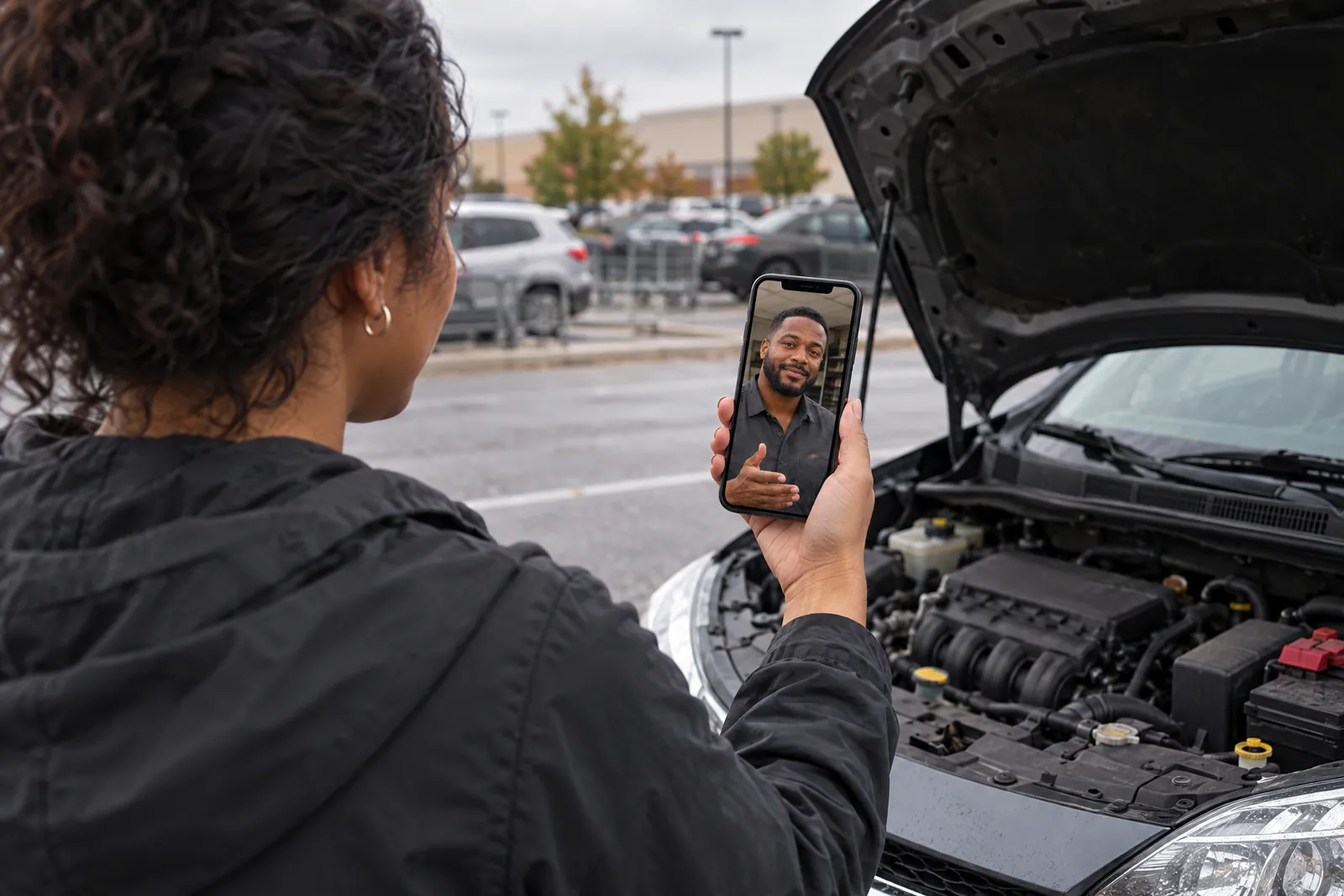
A mechanic on a video call, wherever the car quit
Stuck in a parking lot with a car that won't start, staring at a new light on the dash, or halfway through a repair in your own garage? Show us on your phone. A real mechanic walks you through it, tells you what's wrong and what to do next.
Four reasons people call
It won’t start
Clicking, cranking with no fire, or nothing at all. We narrow it down to the battery, starter, fuel, spark or the anti-theft system, often in a few minutes.
A light came on
We tell you what the light means, whether it’s safe to keep driving, and what it will likely take to fix.
You’re doing it yourself
A second opinion before you buy parts, help reading your scan-tool data, or a mechanic watching over your shoulder through a tricky step.
You got a quote
Not sure a shop’s diagnosis or price makes sense? Show us the estimate and the car and we’ll tell you what we think.
If you're on a highway shoulder or anywhere near moving traffic, turn on your hazards, get everyone out of the car and away from the road, and call 911 or your roadside assistance first. We'll never ask you to work on a car next to traffic. Once you're safe, we can help you figure out what happened and whether it needs a tow, a jump or a mechanic.
You're not alone: AAA rescued a record 32 million drivers in one year, and battery failures, flat tires and keys locked inside are still its top three calls.
What it sounds like tells us a lot
Most no-start problems fall into a handful of patterns. On the call we'll ask you to turn the key while we listen, watch the dash lights, and sometimes check the battery with a multimeter. A healthy battery reads about 12.6 volts with the car off; much below 12.2 and it's likely too weak to crank.
We'll also have you turn the key to "on" without starting and listen for a two-second hum from the back of the car. That's the fuel pump priming. No hum is a clue.
- No sound, no lights. Usually a dead battery, a loose or corroded battery cable, or a blown main fuse.
- Rapid clicking. The starter is trying but the battery can’t supply enough current. A weak battery or a bad connection is the usual cause.
- One loud click, then nothing. Points toward the starter motor, its relay or the wiring to it.
- Cranks normally but won’t fire. Fuel, spark or the anti-theft immobilizer. We’ll have you listen for the fuel pump and check the security light.
- Starts, then dies. Often the immobilizer not recognizing the key, an idle air or throttle problem, or low fuel pressure.
- No sound, no lights
Usually a dead battery, a loose or corroded battery cable, or a blown main fuse.
Check: battery, main cable, fuse - Rapid clicking
The starter is trying but the battery can’t supply enough current. A weak battery or a bad connection is the usual cause.
Check: battery charge, terminals - One loud click, then nothing
Points toward the starter motor, its relay or the wiring to it.
Check: starter, relay, wiring - Cranks normally but won’t fire
Fuel, spark or the anti-theft immobilizer. We’ll have you listen for the fuel pump and check the security light.
Check: fuel pump, spark, immobilizer - Starts, then dies
Often the immobilizer not recognizing the key, an idle air or throttle problem, or low fuel pressure.
Check: key/immobilizer, idle, fuel pressure
Red means stop. Amber means soon.
Warning lights follow a color code: red is serious and usually means pull over, amber or yellow means get it checked soon, and green or blue just tells you a system is on. Here's what the common ones mean. On a call, we'll tell you exactly what yours means for your car.
| Light | Color | What to do |
|---|---|---|
| Check engine, steady | Amber | A fault code is stored. Usually safe to drive for now; get it scanned soon. A loose gas cap is the classic easy one. |
| Check engine, flashing | Amber | A severe misfire. Ease off, avoid hard acceleration and get it checked right away. Unburned fuel can overheat and ruin the catalytic converter. |
| Oil pressure | Red | Pull over and shut the engine off as soon as it’s safe. Driving with no oil pressure can destroy an engine in minutes. |
| Engine temperature | Red | The engine is overheating. Pull over and turn it off. Never open a hot radiator cap. |
| Battery / charging | Red | The car is running on battery power alone, usually a failed alternator or belt. You have limited time before it dies. |
| Brake warning | Red | Check that the parking brake is fully released. If it is, brake fluid may be low; don’t keep driving until it’s checked. |
| Tire pressure (TPMS) | Amber | One or more tires is low. Check pressures before you drive far; a light that flashes then stays on points to a sensor fault. |
| ABS | Amber | Normal brakes still work, but anti-lock braking is off. Leave extra room when stopping. |
| Airbag (SRS) | Red | The airbags may not deploy in a crash. Get it diagnosed soon. |
General guidance only. Your owner's manual has the exact meaning of every light on your car.
Book, show us, get an answer
- Tell us what's happening. Send the form or call. Add a photo of the dash if you can.
- We text you a link. Pay the $49 flat fee and join on FaceTime, Google Meet, WhatsApp or Zoom. Same day, often within the hour.
- Up to 30 minutes with a mechanic. Point the camera where we ask, listen and test along with us.
- You get a written summary. The likely cause, parts that would fix it, whether it's safe to drive, and the next step.
- Need hands on it? We can send a mechanic to you. Book within 7 days and the call fee comes off the bill.
What helps on the call
- Your phone, charged, with the camera working
- The year, make and model, or the VIN from the dash or door jamb
- A flashlight. The phone light works, but a second light helps
- An OBD-II scan tool if you have one; a $20 Bluetooth reader is plenty
- A multimeter if you have one, for checking battery voltage
- Photos of the dashboard with the key on, to send before the call
What a video call can't do
Some faults need hands and test equipment: problems that come and go, internal engine or transmission issues, and many electrical faults. If we can't narrow it down on camera, we'll tell you plainly instead of guessing. For brakes, steering and airbags, we'll recommend a hands-on repair rather than talking you through it.
Request a video diagnosis call
Tell us the car and what it's doing. We'll text you a link, usually within the hour during business hours.
- $49 flat fee, up to 30 minutes
- Written summary after every call
- Fee credited if you book a visit within 7 days
- Works from a parking lot, a garage or your driveway